Back to Search

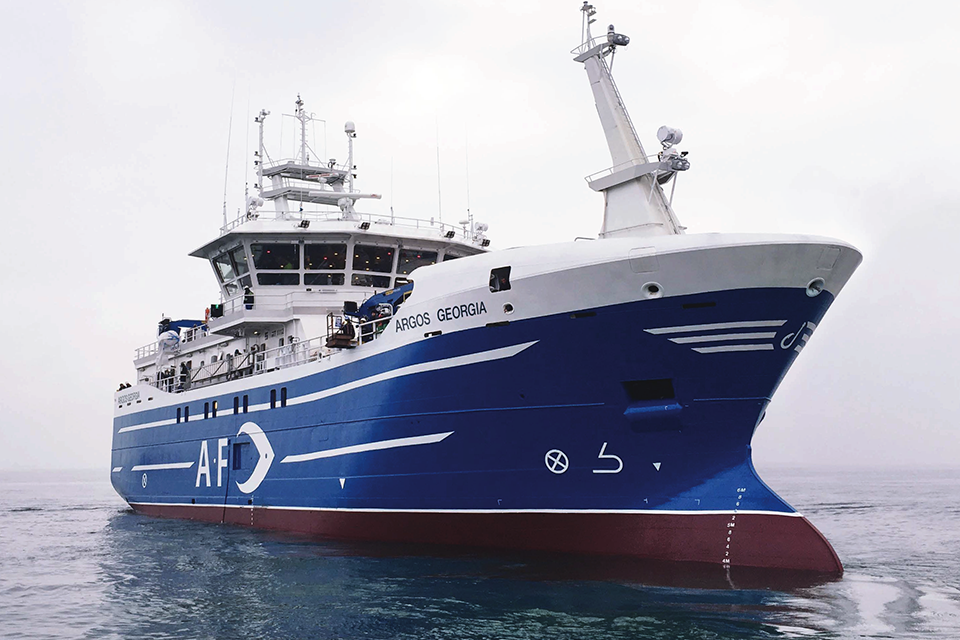
Foundering of the fishing vessel Argos Georgia with the loss of 13 lives

Marine Accidents (MAIB)

Published on 25 September 2026, 10:00

Summary
Location: approximately 190 nautical miles east of Port Stanley, Falkland Islands.
date of occurrence
2024-07-22
report type
investigation-report-on-behalf-of-red-ensign-group
vessel type
fishing-vessel

Report Overview

Accident Investigation Report 19/2026

Read our marine accident investigation report, which includes what happened, subsequent actions taken and recommendations.
MAIB investigation report 19-2026: Argos GeorgiaDownload

Argos Georgia

Summary

Argos Georgia was a longline fishing vessel registered in St Helena. The vessel foundered while on passage from Port Stanley in the Falkland Islands to fishing grounds near the island of South Georgia. Of the 27 people on board, 13 lost their lives.

This overview has been truncated. Please refer to the official documents below for the complete canonical report.

Official Documents

Document Content Preview

Extracted text from the first few pages of the official documents.

MAIB investigation report 19-2026: Argos Georgia

ACCIDENT REPORT ACCIDENT REPORT Report on the investigation of the foundering of the longline fishing vessel Argos Georgia approximately 190 nautical miles east of Port Stanley, Falkland Islands with the loss of 13 lives on 22 July 2024 VERY SERIOUS MARINE CASUALTY REPORT NO 19/2026 SEPTEMBER 2026 Extract from The United Kingdom Merchant Shipping (Accident Reporting and Investigation) Regulations 2026 – Regulation 5: The sole objective of a safety investigation into an accident under these Regulations is the prevention of future accidents through the ascertainment of its causes and circumstances. It is not the purpose of such an investigation to determine liability nor, except so far as is necessary to achieve its objective, to apportion blame. NOTE This report is not written with litigation in mind and, pursuant to Regulation 19(1) of The Merchant Shipping (Accident Reporting and Investigation) Regulations 2026, shall be inadmissible in any judicial proceedings concerning liability unless the Chief Inspector of Marine Accidents or a court of law determine otherwise. © Crown copyright, 2026 You may re-use this document/publication (not including departmental or agency logos) free of charge in any format or medium. You must re-use it accurately and not in a misleading context. The material must be acknowledged as Crown copyright and you must give the title of the source publication. Where we have identified any third party copyright material you will need to obtain permission from the copyright holders concerned. Front cover image from Argos Froyanes Limited All MAIB publications can be found on our website: www.gov.uk/maib For all enquiries: Marine Accident Investigation Branch First Floor, Spring Place 105 Commercial Road Southampton SO15 1GH United Kingdom Email: iso@maib.gov.uk Telephone: +44 (0)23 8039 5500 Press enquiries during office hours: +44 (0)19 3244 0015 Press enquiries out of hours: +44 (0)30 0777 7878 CONTENTS GLOSSARY OF ABBREVIATIONS AND ACRONYMS SYNOPSIS 1 SECTION 1 – FACTUAL INFORMATION 2 1.1 Particulars of Argos Georgia and accident 2 1.2 Background 3 1.3 Narrative 3 1.3.1 Port Stanley activities 3 1.3.2 Passage to the fishing grounds 5 1.3.3 Water ingress and crew actions 6 1.3.4 Deployment of lifesaving apparatus and abandon ship 8 1.3.5 Emergency response 9 1.3.6 Search and rescue 13 1.4 Environmental Conditions 16 1.5 Argos Georgia16 1.5.1 Vessel management 16 1.5.2 Design and construction 17 1.5.3 Certification and survey 18 1.5.4 Argos Georgia crew and marine observers 19 1.5.5 The deceased 20 1.5.6 Lifesaving appliances 21 1.5.7 Bilge pumping arrangements 21 1.5.8 Emergency and communication facilities 22 1.5.9 Maritime and Coastguard Agency review of longline fishing vessels 22 1.6 Line hauler room, side hauling hatch and internal doors 23 1.6.1 Line hauler room 23 1.6.2 The line hauling hatch 23 1.6.3 Line hauler room and conveyor belt room internal doors 24 1.6.4 Electrical and hydraulic control systems 24 1.6.5 Line hauling hatch modifications and repairs 26 1.6.6 Hatch and internal doors operating and closing requirements 28 1.6.7 Drive mechanism material testing 28 1.6.8 Drive mechanism finite element analysis 28 1.7 Stability 30 1.7.1 Stability information book 30 1.7.2 Post-accident stability modelling 31 1.8 Safety management 33 1.8.1 Health and safety system 33 1.8.2 Emergency response plan 34 1.8.3 Emergency and safety equipment supply 35 1.8.4 Risk assessments 35 1.8.5 Training and drills 36 1.9 Sea survival 37 1.9.1 Cold water survival 37 1.9.2 Sea survival predictions 37 1.9.3 Immersion suit pool trial 38 1.10 South Atlantic search and rescue coordination and distress alerting 38 1.10.1 International search and rescue framework 38 1.10.2 Falkland Islands search and rescue area of responsibility 38 1.10.3 Falkland Islands search and rescue arrangements 39 1.10.4 His Majesty’s Coastguard support agreement 39 1.10.5 British Forces South Atlantic Islands support 40 1.10.6 Global Maritime Distress and Safety System sea areas and distress alerting 40 1.10.7 Falkland Islands Maritime Authority communications equipment 41 1.11 Regulation and guidance 41 1.11.1 Code for Recognized Organizations 41 1.11.2 Construction and operating standards 41 1.11.3 Classification society fishing vessel rules 42 1.11.4 Flooding 43 1.11.5 Emergency drills 44 1.11.6 Voyage planning and operational preparedness 44 1.11.7 Fishing vessel safety management 44 1.12 Similar accidents 45 1.12.1 Østbanken – foundering 45 1.12.2 Fay – foundering 46 1.12.3 Villa de Pitanxo – sinking, with loss of 21 lives 46 1.12.4 Kambur – foundering 46 SECTION 2 – ANALYSIS 48 2.1 Aim 48 2.2 Overview 48 2.3 The accident 48 2.3.1 Flooding and loss of stability 48 2.3.2 Uncommanded opening of the line hauling hatch 49 2.3.3 Inability to close internal weathertight doors 51 2.3.4 Door management 52 2.4 Emergency response 52 2.4.1 On board emergency response 52 2.4.2 Raising a distress 53 2.4.3 Escalation of the casualty 54 2.4.4 Abandonment 55 2.4.5 Sea survival 56 2.5 Safety management 57 2.5.1 Management assurance 57 2.5.2 Emergency preparedness 58 2.6 Oversight and approval 59 2.6.1 In build survey and inspection 59 2.6.2 Approval and function of line hauling hatch securing method 59 2.6.3 Line hauling hatch modification process 60 2.6.4 Argos Georgia design 60 2.7 Search and rescue 61 2.7.1 Search and rescue response 61 2.7.2 Search and rescue coordination model in the South Atlantic 62 2.7.3  Search and rescue communications capability in the Falkland Islands Area of Responsibility 63 SECTION 3 – CONCLUSIONS 64 3.1 Safety issues directly contributing to the accident that have been addressed or resulted in recommendations 64 3.2 Safety issues not directly contributing to the accident that have been addressed or resulted in recommendations 65 3.3 Other safety issues not directly contributing to the accident 65 SECTION 4 – ACTIONS TAKEN 66 4.1 MAIB actions 66 4.2 Actions taken by other organisations 66 SECTION 5 – RECOMMENDATIONS 68 FIGURES Figure 1: Argos Georgia main deck general arrangement Figure 2: The line hauling hatch Figure 3: Location of accident and disposition of supporting vessels Figure 4: Argos Georgia as viewed from the fixed-wing aircraft on arrival at the scene Figure 5: Last light observed from Argos Georgia by the fixed-wing aircraft at about 1835 Figure 6: Search and rescue assets and recovery locations Figure 7: Argos Georgia liferafts as located by search vessels, viewed from the fixed‑wing aircraft Figure 8: Argos Georgia side hauling hatch assembly and controls Figure 9: Argos Georgia side hauling hatch operating mechanism and locking arrangement Figure 10: Disposition of the doors and operating controls Figure 11: Extract from the finite element analysis report Figure 12: Extract from Argos Georgia stability information book Figure 13: Likely progressive flooding of Argos Georgia main deck TABLES Table 1: List of the deceased and missing crew members Table 2: Developing loss scenarios Table 3: Vessel safety risk assessment examples ANNEXES Annex A: MAIB Safety Bulletin SB4/2024, issued 10 October 2024 Annex B: MAIB safety flyer to the fishing industry GLOSSARY OF ABBREVIATIONS AND ACRONYMS 2/E - second engineer 2/O - second officer 3/E - third engineer AFL - Argos Froyanes Limited AGL - Argos Georgia Limited AIS - automatic identification system AOL - Argos Operations Limited (Gibraltar) AoR - Area of Responsibility Argos FI - Argos Limited (based in the Falkland Islands) BFSAI - British Forces South Atlantic Islands C/E - chief engineer C/O - chief officer CAP - Central Alerting Post CEC - Certificate of Equivalent Competency CESM - Cold Exposure Survival Model COG - course over t

Text truncated. The original document has 86 pages.

Read the full text here

Change History

  • First published.

Related Entities

Search the database for other reports involving these entities.